
Is Your Vitamin C Serum Getting Darker? Here’s What the Color Really Means
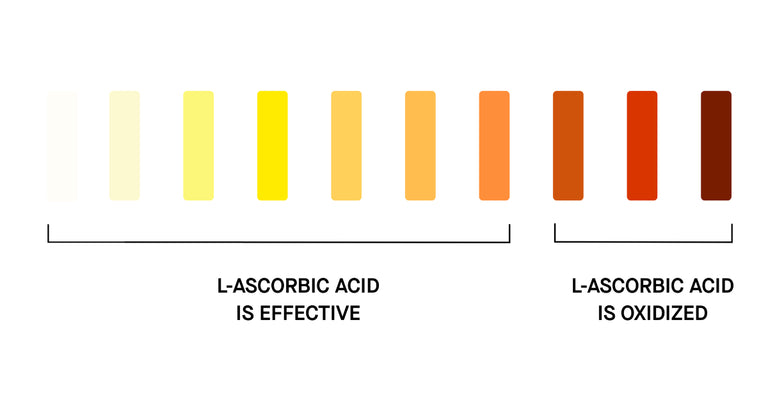
Why Does Vitamin C Serum Get Darker?
The short answer: oxidation.
L-ascorbic acid, the pure form of Vitamin C used in many skincare formulas, is a powerful antioxidant — but it’s also naturally unstable. Exposure to oxygen, light, and heat can cause it to oxidize over time, which may change the serum’s color from clear or pale yellow to a deeper yellow or orange.[1][2]
Translation: Vitamin C changing color isn’t random. It’s chemistry.
Does Heat Make Vitamin C Oxidize Faster?
Yep. Higher temperatures can speed up the oxidation of L-ascorbic acid.[1]
That means hot delivery trucks, warm porches, or storing your serum somewhere sunny can all play a role in how quickly its color changes.
But a warmer-than-usual trip to your doorstep doesn’t automatically mean your serum is bad. Once it’s home, keep your Vitamin C tightly closed and away from heat and direct light.
Want to give it a little extra chill? Storing it in the fridge can help slow L-ascorbic acid oxidation, especially during warmer months.
Your sunny bathroom windowsill? Great for a plant. Not so much for Vitamin C.
Is Yellow Vitamin C Serum Still Effective?
Here’s where things get less black and white. Oxidation is a process, not an on/off switch.
A slight color change does not automatically mean all of the active L-ascorbic acid is gone. But as oxidation continues, the amount of intact Vitamin C can decrease.[1]
Color can give you a hint about what’s happening, but it doesn’t tell the whole story. A slight change doesn’t necessarily mean your serum has gone bad.
If it becomes significantly darker or you notice changes in smell or texture, it may be time for a fresh bottle.
Why Our Formula Matters
Brandefy’s Clinical Vit C + E + Ferulic Defend Serum contains 15% L-ascorbic acid, Vitamin E, and 0.5% ferulic acid.
That combination matters.
Research has found that adding ferulic acid to formulas containing Vitamins C and E can improve their chemical stability.[3] The combination has also been studied for its antioxidant and photoprotective benefits in human skin.[4]
L-ascorbic acid itself is also one of the most extensively researched forms of topical Vitamin C, with studies supporting its skin penetration and antioxidant benefits when properly formulated.[5][6]
Basically: Vitamin C may be a little high-maintenance, but there’s a reason we keep it around.
The Bottom Line
If your Vitamin C serum is getting slightly darker, don’t panic.
L-ascorbic acid naturally oxidizes over time, and heat, oxygen, and light can speed up the process. A small color change doesn’t automatically mean your serum has gone bad, but significant darkening can be a sign of more advanced oxidation.
Keep it cool. Keep it dark. Keep the cap tight.
And if your Brandefy Clinical Vit C + E + Ferulic Defend Serum arrives looking noticeably darker than expected? Reach out. We’re happy to take a look.
Sources
[1] Stability of Vitamin C and factors affecting ascorbic acid degradation.Source
[2] Vitamin C in dermatology and its stability in topical formulations. Source
[3] Lin FH, et al. Ferulic Acid Stabilizes a Solution of Vitamins C and E and Doubles Its Photoprotection of Skin. Journal of Investigative Dermatology, 2005. Source
[4] Murray JC, et al. A Topical Antioxidant Solution Containing Vitamins C and E Stabilized by Ferulic Acid Provides Protection for Human Skin Against Damage Caused by Ultraviolet Irradiation. Journal of the American Academy of Dermatology, 2008. Source
[5] Pinnell SR, et al. Topical L-Ascorbic Acid: Percutaneous Absorption Studies. Dermatologic Surgery, 2001. Source
[6] Al-Niaimi F, Chiang NYZ. Topical Vitamin C and the Skin: Mechanisms of Action and Clinical Applications. Journal of Clinical and Aesthetic Dermatology, 2017. Source